
Journey of a Thousand Miles
Probably everyone is at least vaguely familiar with the Chinese proverb that I’ve borrowed and clipped for the title of this blog entry.
I’m not really thinking of taking the first step towards a goal that seems insurmountable at the beginning though.
Rather, I have one mundane and one not so trite idea in mind.
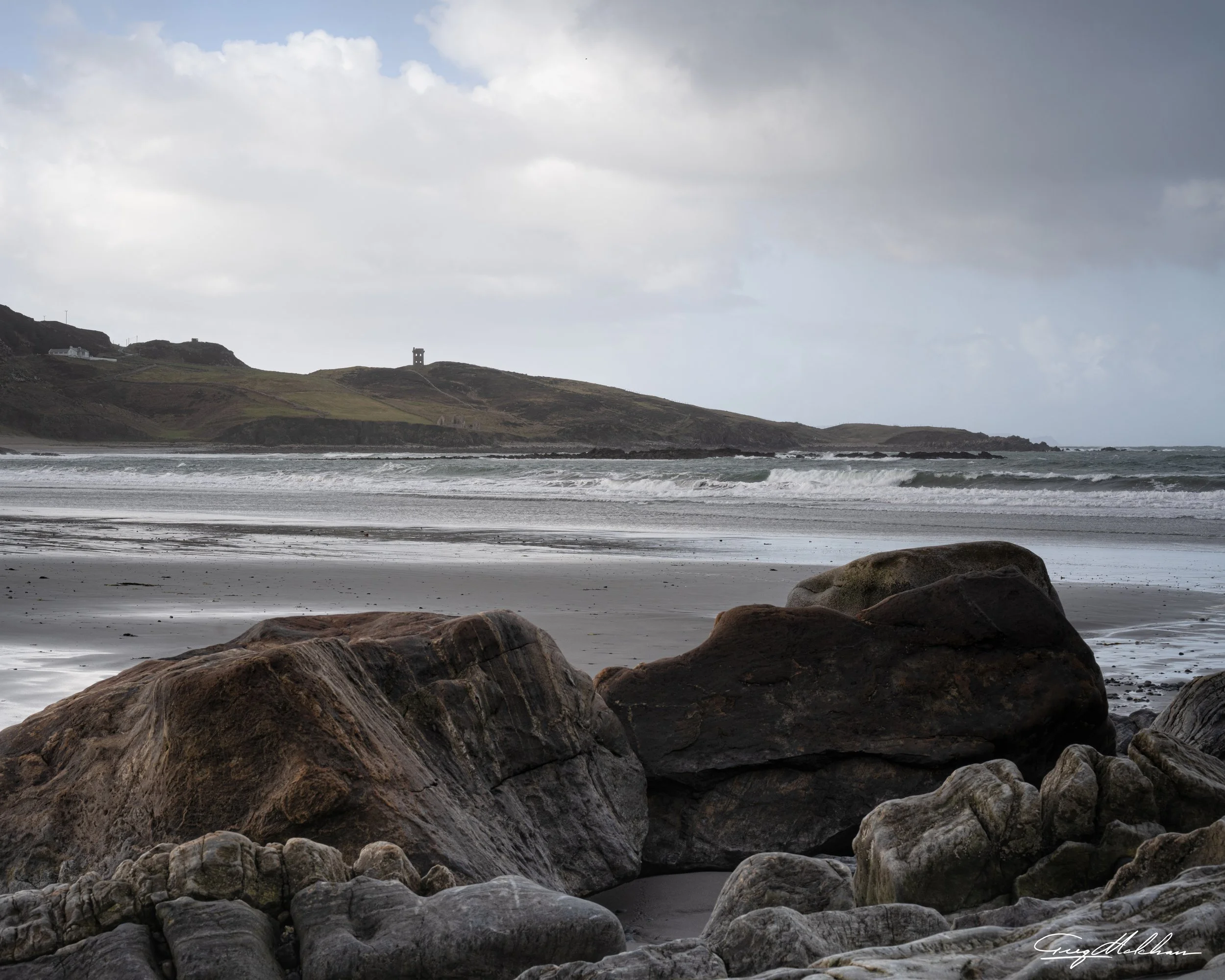
Regarding the former, I was standing on a beach on Ireland’s west coast quite far from home when I took this image.
It was my first full day in Éire.
I had not been to the emerald isle before. I did not know a single person.
And I had no real plan at this point, having already done my morning shoot at nearby Crohy Sea Arch.
Things did not go as I was envisioning there.
Although I was hoping for moody weather, gale force winds made scrambling down to sea level impossible. Nor could I set up with my tripod.
In the end, I had to shoot handheld while I was pelted in the face with hail and knocked about enough that I didn’t get more than the odd sharp photo of rough seas crashing into sea stacks.
Although the weather was still on the rough side—I think all the shots are again handheld—this strand seemed quite idyllic compared to that initial experience.
So I made an impromptu decision to stop instead of continuing the hour-long drive back to where I was staying.
With respect to the latter of the two themes I mentioned, I’m increasingly drawn to the kind of composition that depicts a journey.
There are a lot of ways to accomplish that when framing a scene.
Using leading lines, for instance, to take the viewer through the image.
There is an invisible through line here from the rocks in the foreground, to the less prominent ruins in the middle, to the shell of the tower on top of the hill at the edge of the middle area and background.
But it’s not just the technical aspects of composition that I think help tell the story here.
It’s also what each of these elements taken together can teach us about this country and its history.
Up close we have rock thrust through the shoreline like spines.
These shapes have been weathered and pock marked over thousands of years by wind and water. You could be standing on the bones of dragons.
Against that much grander timeline we have the more recent but still past traces of a people who made these rugged lands their home.
Who bled and died to protect it and their families. Whose ghosts can be seen everywhere upon the landscape.
But not in a way that sprawls across the earth like we see in so many places today.
Of course urban centers like Dublin, Cork, Kerry, and so on are home to much bigger populations, with over 2 million people sharing the capital.
That said, even driving through one of those cities during my two-week stay, I did not feel any sense of crowding.
Seen from above, the whole of Ireland looks decidedly rural.
I’ll end by saying I think it’s important not to overly romanticize a place and lose sight of what it is and isn’t.
One young Irishman I met where I stayed was quick to remind me that the country’s first inhabitants were warriors and that the island’s history well before the English laid claim to it is steeped in violence and conquest.
I’m unlikely to take that kind photo when I look upon the landscape. Today’s image certainly conveys something far quieter and gentler.
On the flip side of that, scenes like this invite us to deeply reflect upon who we are, what we are doing in the world, etc.
Unless you’re on the wrong side of history and continuing to choose that, reflection is probably a good thing.