Negative Space
This month’s first and possibly only share takes us back to Ireland. This time at Fanad peninsula, which I absolutely adored despite the incredibly narrow roads I navigated at times to reach my destination.
Thankfully traffic was very light that day. Even so, I let everyone go by me when necessary. I deemed that far less stressful for all involved.
Pro tip: the Irish have little compunction about driving at top speed around hair pin turns, over one-way bridges and narrow lanes, and the like.
To be fair, I have experienced that with Americans (presumably) as well, most notably on a 2022 trip to Moab.
Still, I was both impressed and a little bit concerned as I much more tentatively guided my car along the Donegal region’s snaking coast line and up swiftly rising paths cut into the hills.
I wonder if this composition comes across as a bit stereotypical?
I’m asking myself that reflexively because I had the intention of capturing something that screamed Ireland.
As I look back, I have to acknowledge that’s not a very useful way to go about photography.
Or at least the potential for failure is quite high.
That said, I was obsessed with sheep upon seeing my first one. And I saw them everywhere I went.
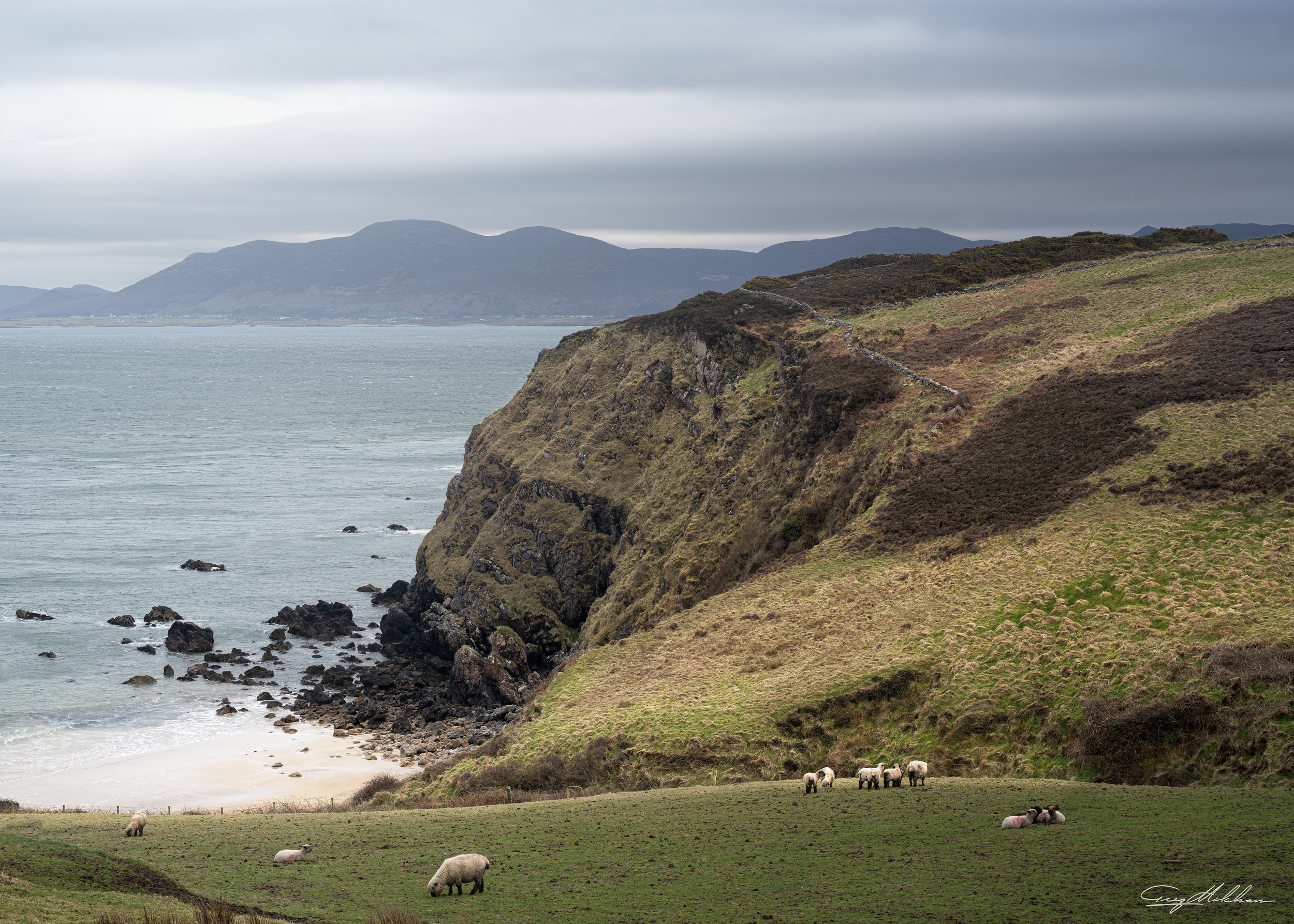
I found the scene I’m sharing quite striking, with the ovine livestock (thanks, MTG for teaching me the former term) lounging about this rugged landscape straddling the Atlantic.
Like they were summering at the beach (it was early April)!
Sheep have been vital to Ireland’s economy for centuries, though basic research tells me that 1) making a living on raising them is moderate; 2) demand has dwindled in recent years.
Make of this what you will.
Right, on to the title for this blog.
What is negative space in photography exactly? Why is it important?
It doesn’t mean empty space, for instance. There’s not much of that in this image.
I’m not going to provide a textbook definition, which I think would be less useful.
I think a more informative way to think about it in composition is, well, counterpoint, to borrow from music theory.
I suspect this idea cuts across many other art forms.
In photography, it’s space that balances out the main subject or primary areas that we as the visual storyteller want our viewers to focus on.
This could mean a difference in warm and cold colors. Or relatively dark and light areas.
It can also be quite literal / physical.
Here, the hyper-sharp land formation at right takes up about two-thirds of the frame (full disclosure, I’ve cropped the original frame in to accentuate this effect).
Whereas the less distinctive ocean occupies the remaining one-third at left. More or less.
This kind of thinking is very much elemental in photography, whether you’re a landscape photographer, a portrait photographer, a wildlife photographer, or what have you.
There is no rule that says you can’t make an image 50/50, 80/20, 70/30, etc.
I’ve experimented with these and succeeded.
But I’d say going for a two-thirds positive and one-third negative arrangement works better in most instances.
Similarly, an odd number of elements seem to be more aesthetically pleasing.
I’ve cloned out some sheep that were distracting / on top of each other where possible. I naturally landed on the final 11 you see.
That tightly clustered group at far right may throw you.
But I daresay the three on the left-hand side and eight on the right counterpoint each other nicely.
I’m reminded as I wrap this blog up of Kurt Vonnegut’s analysis of what makes a story successful.
He beautifully and accurately imo maps out what seems to resonate with people most strongly.
I highly encourage you to look this up, whether you are a photographer, a short story writer, another kind of artist, or none of the above.
Photography works this way, for some reason.
I don’t think I can explain it.
I don’t think I really want to do so either.
I just know after lots of practice.
I’ll end by saying the obvious thing: a compelling composition needs some kind of balance, a type of interplay between something we tend to view as “positive” and something else we label as “negative.”
That’s not the simple dichotomy between good and bad.
It’s opposing forces, if you will, that cannot be understood on their own. Each bit helps to form the whole. They need each other. They are complementary
That’s it for today!