
Let’s Get Medieval!
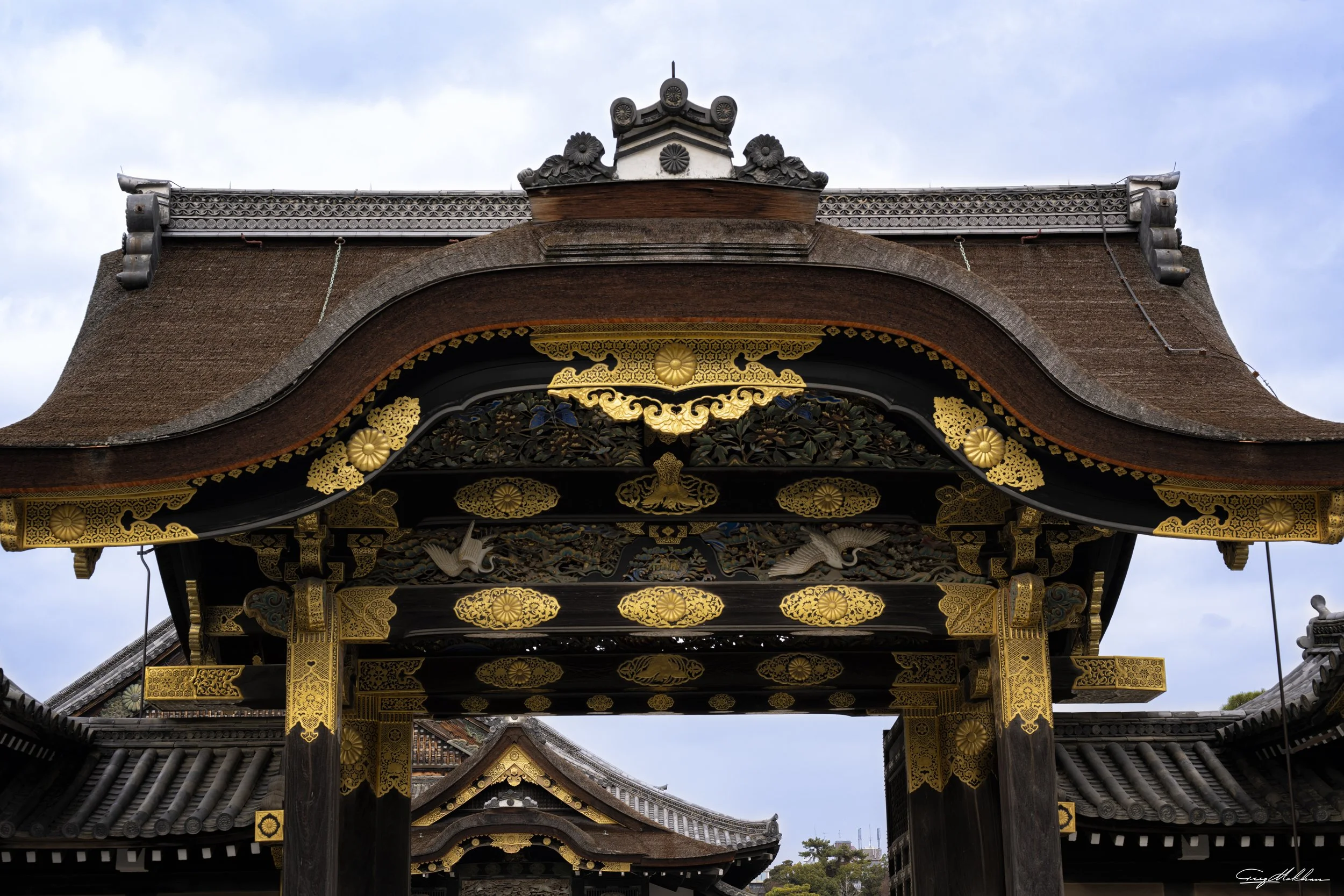
Karamon gate facing inwards towards the Ninomaru palace. Nijo Castle, Kyoto.
Well, 1601, when construction began on Nijo Castle at Kyoto (completed in 1624), is more properly the beginning of the Shogunate period in Japan.
But I focused on medieval lit in graduate school, so I’m stretching definitions a bit so that I can connect the two.
I did take an Eastern Asian Literary Traditions seminar my first or second term. The Japanese third of the course covered Noh drama, The Tale of Genji, Man’yoshu, Kokinshū and Shinkokinshū, and of course the poems of Basho.
Possibly some other stuff I no longer remember decades after the fact.
Fittingly, Basho hails from the region and wrote during the period in question.
Also, by happenstance, he died in Osaka on the day I was born, some 300 years apart or thereabouts.
Most Americans are familiar with haiku even if they don’t know anything by this master of the art form. Many of us try our hand at them in secondary school as part of our education.
I started to compose one on the bullet train from Kyoto to Mishima earlier in my trip. I need to make time to finish it.
I consider my brief visit to this remnant of Edo Japan one of the highlights. I was just as much fanboying as I walked the palace grounds and gardens as I was looking for likely compositions.
It’s awfully hard not to romanticize a place like this with its lavish architecture and brightly colored adornments, its well-tended flora, and its meticulously painted interiors.
Especially when 1) it’s your first visit to a very different country from the one you live in; 2) you have been fascinated by the literature of other cultures and time periods and have studied them; 3) you’re aiming in large part with your photography to capture the flavor of the nation, with an emphasis on its beauty.
I will say that, between YouTubers sharing their experiences, what I saw at times in country, and recent news reports I’ve read, I have a somewhat healthier appreciation for what Japan is and what it isn’t.
I probably spent more time here at the Karamon main gate to the Ninomaru palace than most other folks.
I photographed it on the way in and out, in fact.
There were a few other people setting up portraits with portable tripods and 360-style cameras when I first arrived, as I recall.
This required some patience, and in the end I wasn’t able to get the whole gate before someone invariably wandered into frame.
I’m hardly a stranger to that kind of thing at this point. I tend to get creative and look for odd angles, both to engage the viewer in my work and to eliminate distractions.
Sometimes a person or something unexpected does add an interesting element to the story, though that was not the case here.
I’ve also been intentionally taking time to capture more than just the sweeping scene that is the bread and butter of landscape photography.
Pulling out the details can help deepen the story of a place.
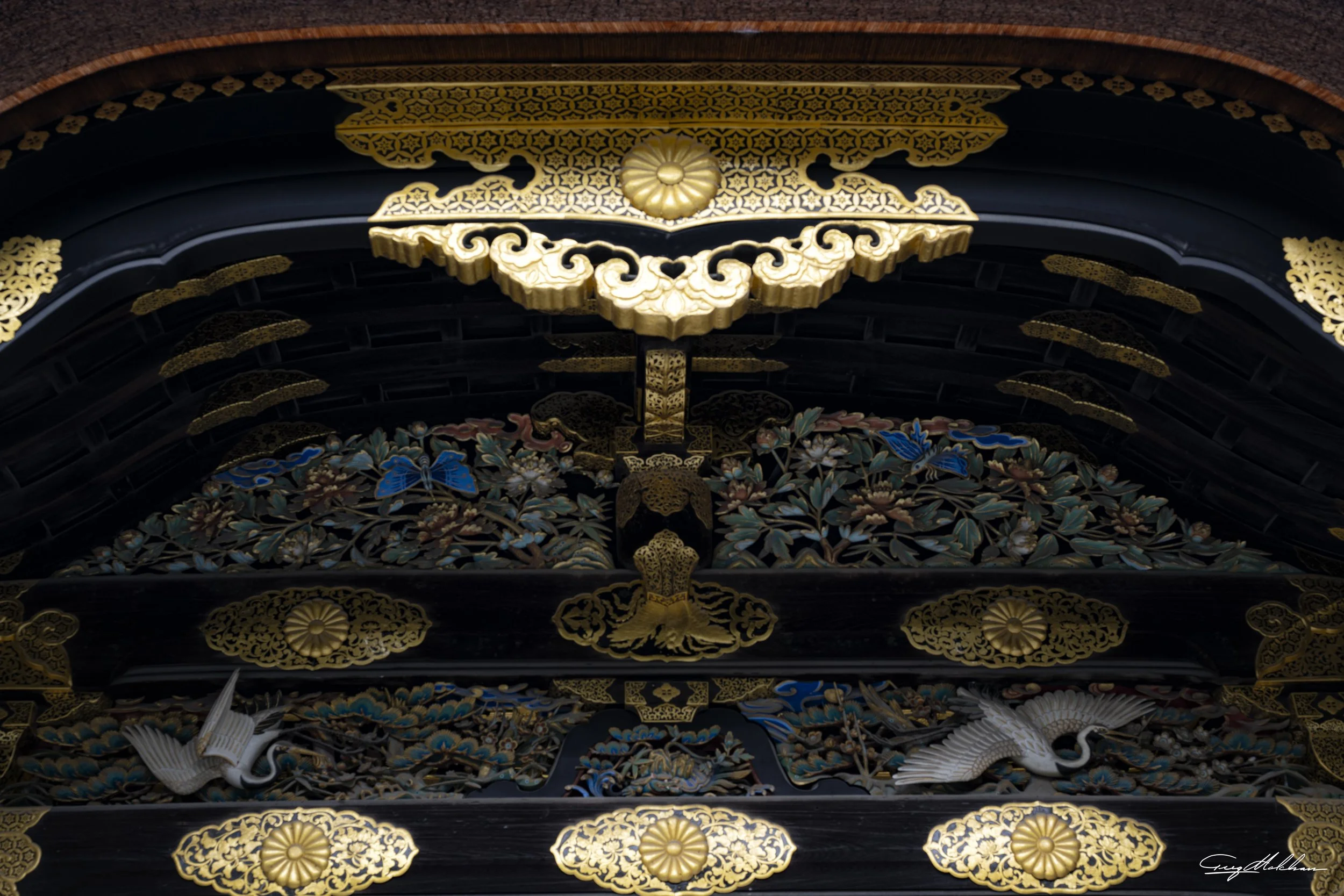
Detailed artwork on the inward facing side of Karamon gate, Nijo Castle, Kyoto.
Here, we can see just how intricate the metal work and ornamentation on the gate is.
Similar but unique scenes of cranes, butterflies, and blooming flowers also grace the outward facing side of the gate and other buildings on the grounds.
I’ll end by saying that I have been hard at work curating the thousands of photos I came home with.
With this and the fact that I’m sharing two photos today in mind, I’m choosing self-care rather than force myself to get out into nature this month to photograph things closer to home.
Plus it’s been abominably cold, though the last few days have been slightly less so. They promise, I hope, that spring is not too far off.